 Penny
Penny

“We’re paying thousands for accounting software and Claude can do it in a few sentences. I guess the SaaSpocalypse continues?” - literally a quote from a small business I know.
It’s a fair question especially since we can in 3-4 sentences build something about 80% of the way there. I’ve seen CPAs with 45 years of experience build reconciliation tools that intake bank statements and spit out a P&L… all through the magic of prompt engineering.
I’m all for exploring and being scrappy by building tools internally, plus they’re a lot more custom than the off-the-shelf solutions. Let’s be honest, it feels nice to build things yourself…The first close cycle typically looks like magic, then month-end hits and you’ve now went from CPA to CTO (Chief Technology Officer, the I.T. team). You’re now spending hours and hours de-bugging, checking accuracy, making sure it fits with your workflows, and lord knows that else, just to get this AI magic to work.

In that time you could’ve easily finished the file… multiple times over.
The Build Tax
I want to give this pattern a name, because naming it makes it easier to recognize before it gets expensive: The Build Tax.
It’s the compounding operational cost that accumulates when you use AI for workflows that were never designed to be improvised. This type of cost isn’t one of those one-time implementation cost that will lead to 10K hours saved forever, it ends up compounding on itself.
Every close cycle adds a little more friction, a little more manual work and fragility until the team is now partially managing AI infrastructure on top of doing their actual jobs.
The Build Tax isn’t obvious at first because the first build usually works (80-90% of the time). In this example, the problem is that closing the books is a system and AI was designed for tasks.
Where the Tax Actually Shows Up
After watching 30+ accountants navigate this, the costs tend to cluster in the same six places.
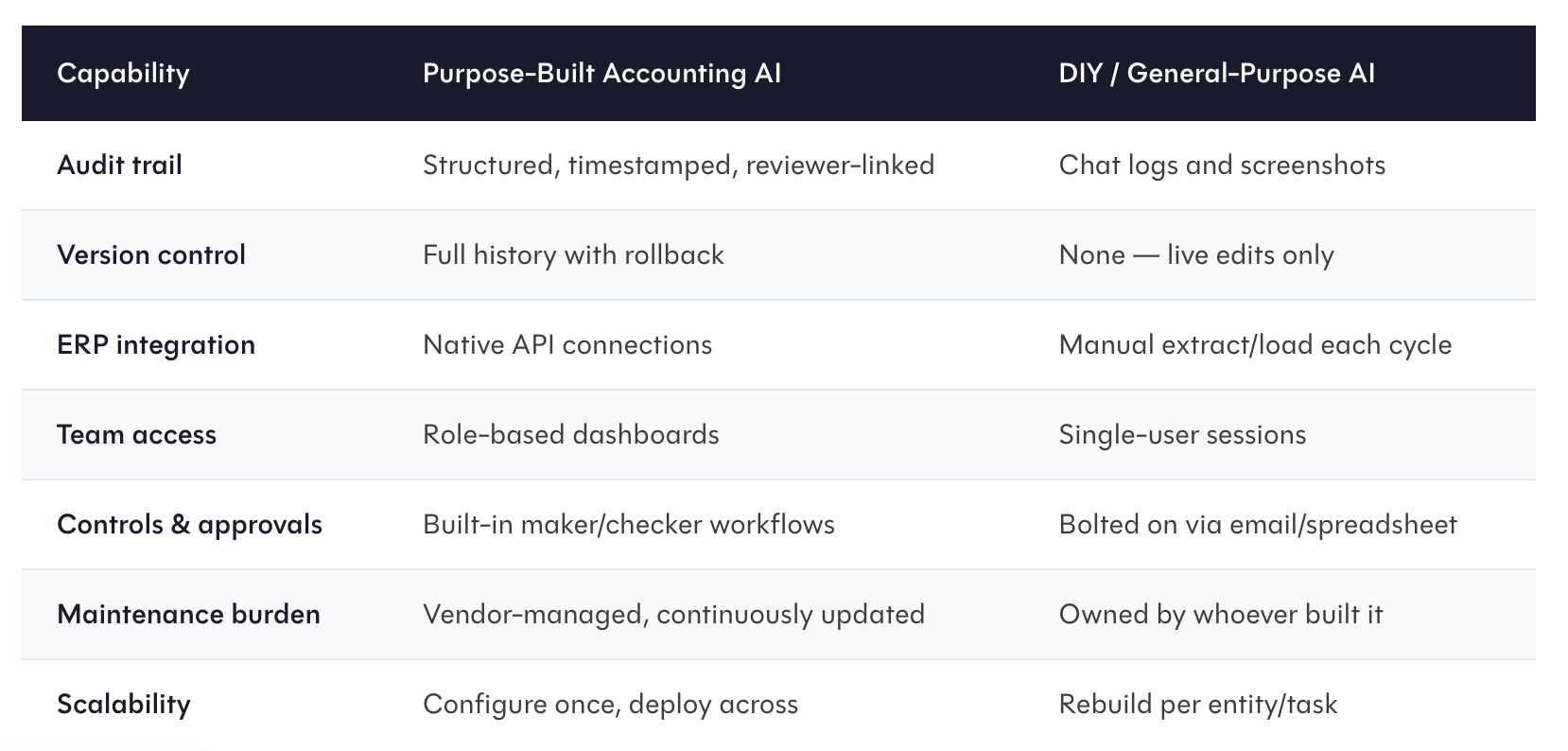
- Key person dependency: when an accountant builds an AI agent, that logic lives in their session, prompt library and their mental model. There’s no handoff document, central repository or operations dashboard. If they’re sick during the close the agent’s institutional knowledge leaves with them. In a profession that’s lost hundreds of thousands of practitioners over the past few years, building single-point-of-failure AI workflows is a big risk.
- The Excel problem: only accountants know this but real accounting workbooks aren’t clean. It’s laughable to assume that the data you get from clients are perfectly structured and 100% accurate. They’re multi-tab, cross-referenced, conditionally formatted, formula-layered documents that have evolved over years of institutional knowledge baked into them. AI tools handle clean data reasonably well but these messy files, not as much. There’s a difference between “process this CSV” and “make sense of this 50-tab workbook with nested INDIRECT formulas and a lookup table on the hidden tab.”
- Integration overhead: I have a friend who works at a massive corporation, and every month end they extract data from an ERP, reformat it and reconcile it against multiple places and then load it into AI. The time the AI saves on the analysis gets partially eaten by the manual prep it requires to run. At scale, this overhead is quite material.
- The Auditability gap: under the hood of all accounting programs are audit trails. You need to demonstrate how the output was produced, who reviewed it, what controls were in place, and when. I’ve met controllers who are trying to explain AI-generated variance analyses to auditors by essentially pulling up a conversation thread. I repeat: a chat log is not an audit trail.
- Version fragility: chart of accounts change, entities adds and materiality changes overtime too. In a purpose-built system, these changes go through a configured update. In a DIY setup, they get edited live, with no sandbox and no version history (ask an engineer why this isn’t a good idea). One bad prompt update during a close cycle and that may give you 10 hours of debugging.
- Controls vacuum: enterprise accounting runs on controls (i.e. maker/checker workflows, reviewer sign-offs, segregation of duties, documented approvals). AI has none of these concepts built in, so they bolt them on in the build (i.e. sharing outputs via email, tracking approvals in spreadsheets, manually documenting reviews). They’ve rebuilt the manual processes they were trying to eliminate, except now with an AI step in the middle that nobody fully owns.
What Matters
Most people discuss this as a “build vs. buy” question, it’s a feature and cost comparison. The deeper question is: who carries the operational burden?
When you build, your accounting team ends up operating the thing they built, including maintaining integrations, managing versions, documenting audit trails, handling access, checking accuracy, and the list goes on.
Purpose-built platforms, something like Penny AI Tax Preparer, absorb that operational infrastructure.
The AI model’s capability is a bit secondary because what you’re really buying is the audit trail, the version control, connected to your workflows, a control framework, and the team access management that wraps around the model.
MIT’s NANDA initiative found that purchasing AI from specialized vendors succeeds roughly twice as often as internal builds, and that gap widens in regulated, process-intensive functions such as accounting.
The Part Nobody Budgets For
The AI subscription cost is immaterial, it’s between $20-200 depending on your budget a month. The real cost is the operational infrastructure required to make AI reliable, auditable and scalable for your business.
When you build that infrastructure yourself, you’re paying for it with your time, which is not well spent as an I.T. specialist.
Gartner predicted that at least 30% of generative AI projects would be abandoned after proof of concept citing escalating costs, poor data quality, and unclear business value.
So the question becomes, what’s the right approach?
Final Thoughts
I’m not saying that DIY AI is always wrong, or that purpose-built platforms are always right either. There’s so many factors such as context, team size, regulatory exposure, number of clients, etc.
The goal of this article was to expose you to the build tax, and how it compounds fast.
The teams that navigate this well ask themselves: what does this workflow actually require to be trustworthy at scale?
Once you answer that honestly, the build-vs-buy math usually becomes clearer. My thought is that infrastructure is the moat, which is what you’re actually buying when you buy a purpose-built accounting AI platform.